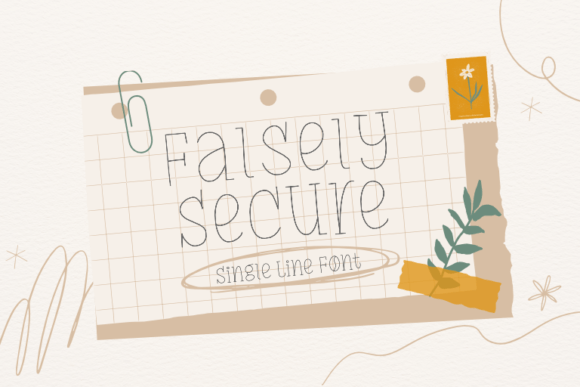
Strategic Typography: Leveraging Falsely Secure for Authentic Brand Communication
In the crowded landscape of digital and print media, the choice of typeface is rarely just an aesthetic decision; it is a strategic one that dictates how your message is received, processed, and remembered. Falsely Secure emerges in this context not merely as a design asset, but as a communication tool with distinct psychological properties. Described as a sweet and friendly single-line font, its natural and unique style offers a departure from the rigid, corporate sterility that often alienates modern audiences. For entrepreneurs, marketers, and creators aiming to build genuine connections, understanding the nuanced utility of Falsely Secure can be the difference between a brand that feels distant and one that feels approachable.
The core value proposition of Falsely Secure lies in its single-line construction. Unlike traditional serif or sans-serif fonts that rely on varying stroke widths to create contrast, single-line fonts maintain a uniform thickness throughout every character. This technical characteristic imparts a sense of honesty and simplicity. There are no hidden flourishes or decorative pretenses; what you see is exactly what you get. When deployed strategically, this transparency can reinforce a brand's commitment to clarity and straightforwardness. However, the "sweet and friendly" descriptor suggests a warmth that prevents the font from feeling too mechanical or industrial. This balance makes Falsely Secure incredibly fitting for a large pool of designs where the goal is to humanize a message without sacrificing professionalism.
Aligning Typography with Brand Positioning and Goals
Before integrating Falsely Secure into any project, decision-makers must evaluate whether the font's personality aligns with their broader strategic goals. Typography acts as the voice of your content before a single word is read. If your objective is to establish authority through tradition and gravitas, a classic serif might be more appropriate. However, if your strategy involves disrupting a stale industry, fostering community, or simplifying complex information, Falsely Secure becomes a powerful ally.
Consider the implications for customer experience. In sectors like education, wellness, or artisanal crafts, the user often seeks reassurance and guidance. The natural flow of Falsely Secure mimics handwriting or sketching, which subconsciously signals that a human hand was involved in the creation process. This can lower barriers to entry for new customers who might feel intimidated by overly polished, corporate aesthetics. By choosing this font, you are making a deliberate decision to prioritize accessibility and warmth over imposing dominance.
Furthermore, the uniqueness of the style supports differentiation. In a sea of generic geometric sans-serifs, Falsely Secure offers a distinct visual signature. For small business owners and freelancers operating with limited budgets, leveraging a unique typeface can be a cost-effective way to elevate brand perception. It signals attention to detail and a willingness to step outside conventional boundaries, traits that resonate deeply with discerning consumers aged 20 to 50 who value authenticity over mass-market appeal.
Practical Applications Across Design and Operations
The versatility of Falsely Secure allows it to function effectively across various mediums, provided it is used with intention. Its legibility and friendly demeanor make it particularly suitable for headlines, logos, and short-form copy where personality needs to shine. However, its application extends beyond mere decoration; it can structure information in a way that encourages engagement.
- Brand Identity Systems: Use Falsely Secure for logo marks and taglines to establish an immediate tone of friendliness. Pair it with a highly legible, neutral body font to ensure readability in longer documents while maintaining the brand's unique voice in key touchpoints.
- Educational Materials: Educators and publishers can utilize the font for diagrams, callouts, and instructional headers. The single-line style reduces visual noise, helping learners focus on the core concepts without distraction.
- Digital Marketing Campaigns: In social media graphics and email headers, Falsely Secure can break the pattern of standard web fonts, increasing click-through rates by catching the eye with its organic feel.
- Packaging and Labels: For product-based businesses, the font works exceptionally well on packaging where space is limited but character is essential. It conveys a "hand-crafted" quality even for manufactured goods.
When planning these applications, consider the hierarchy of information. Because Falsely Secure has a strong personality, it should generally be reserved for elements that require emotional resonance. Using it for dense blocks of text might fatigue the reader due to its monolinear nature, which lacks the guiding serifs that help the eye track long lines of prose. A strategic approach involves using it to highlight key takeaways, quotes, or calls to action, thereby guiding the reader's journey through the content.
Navigating Risks and Contextual Limitations
While the potential benefits are significant, relying on Falsely Secure without clear goals or context introduces specific risks. The primary danger lies in misalignment. If a brand positions itself as a high-end luxury service requiring an aura of exclusivity and formality, the "sweet and friendly" nature of this font could undermine that positioning, making the brand appear amateurish or unserious. Decision-makers must critically assess whether the friendliness of the font dilutes the necessary authority of their message.
Another consideration is legibility at small sizes. Single-line fonts can sometimes lose definition when scaled down significantly, especially on low-resolution screens or poor-quality print stock. Before finalizing any operational rollout, thorough testing across different devices and materials is essential. What looks charming on a desktop monitor may become an illegible scribble on a mobile notification or a business card printed on textured paper.
There is also the risk of overuse. Because Falsely Secure is so distinctive, using it for every element of a design can create visual chaos. It lacks the subtle variation that helps distinguish different levels of information in complex layouts. Strategic restraint is key; treat the font as a spice rather than the main ingredient. Use it to accentuate, not to overwhelm.
Implementing Intentional Design Strategies
To maximize the long-term value of Falsely Secure, creators should adopt a framework of intentional design. This begins with defining the specific emotional response you wish to elicit. Are you trying to soothe anxiety? Spark curiosity? Invite collaboration? Once the goal is clear, determine if the natural style of Falsely Secure supports that outcome. If the answer is yes, proceed with a plan that integrates the font consistently but sparingly.
Planning tips for effective implementation include:
- Audit Existing Assets: Review current branding materials to identify where a shift in tone could yield better results. Replace sterile headings with Falsely Secure to warm up cold interfaces.
- Test Audience Perception: Before a full launch, run A/B tests with a segment of your target audience. Gather feedback on whether the font enhances trust and engagement or creates confusion.
- Establish Usage Guidelines: Create a internal style guide that dictates exactly when and how Falsely Secure should be used. Define acceptable pairings, minimum sizes, and color contrasts to ensure consistency across all teams and freelancers.
- Focus on Whitespace: Single-line fonts often benefit from generous whitespace. Allow the characters to breathe by increasing padding and margins around text blocks, enhancing the clean and open feel of the design.
Ultimately, the limit is your imagination, but that imagination must be grounded in strategic foresight. Falsely Secure is not a magic bullet that automatically fixes poor messaging or weak products. It is a tool that, when wielded by a thoughtful practitioner, can amplify a brand's inherent strengths. By understanding its characteristics, respecting its limitations, and applying it with precision, professionals can craft experiences that resonate on a deeper, more human level. In an era where consumers are increasingly skeptical of polished facades, the honest, unpretentious charm of Falsely Secure offers a pathway to building lasting trust and achieving sustainable growth.